Credit: UN Women Deutschland
Recap: The International Conference: Beijing+30: Delivering for all women and girls


Viele Organisationen erheben regelmäßig Informationen zur der Lage von Frauen und Mädchen sowie der Gleichstellung der Geschlechter weltweit. Hier stellen wir Ihnen einige interessante Informationsquellen vor, auf welche Sie zurückgreifen können.

Viele Organisationen erheben regelmäßig Informationen zur der Lage von Frauen und Mädchen sowie der Gleichstellung der Geschlechter weltweit. Hier stellen wir Ihnen einige interessante Informationsquellen vor, auf welche Sie zurückgreifen können.


Sarah Hendriks (Director of Policy, Programme and Intergovernmental Division, UN Women) underlined that the world is woefully off track when it comes to equal rights and opportunities for women and girls. She therefore presented UN Women’s threefold Beijing+30 strategy: Area 1 is working together with member states and stakeholders. Area 2 puts the focus on civil society in general and especially youth movements. Area 3 looks at the multilateral system and puts gender equality at the centre of the course of action (more in the new brochure).

Aslıhan Tekin (UN Women Europe and Central Asia Bejing+30 Civil Society Steering Committee member) outlined the process of the diverse committee from its establishment through the three rounds of consultation that covered various topics. She stated that the Beijing Platform for Action underscores the vital role of civil society in driving change. In Europe and Central Asia, feminists are the heartbeat of the region, they call for action, participation, collective work and intersectionality – they want the system to change.

Annette Ludwig (Human Rights and Political Department, Permanent Mission of Germany to the United Nations) shared that it was a difficult process, but that multilateral cooperation is alive. It took 18 months and 5 rounds of revisions for the Pact to be finalized. She stated that achieving gender equality is non-negotiable. Even though it is a compromise document, it includes key aspects like the unpaid care economy, sexual and reproductive health, and highlights inclusivity. While at times vague, the goal was not to provide specific outlines – governments must decide on concrete details and implementation. We now need to build on the pact with a feminist perspective.


Papa Alioune Seck (Chief of Research and Data Section, UN Women) presented the report which shows that gender inequality affects economic growth, and every other aspect of sustainable development. Progress is painfully slow, and there is a very high cost of not realizing women’s rights. However, with the right policies and investments, achieving equality is within reach. The political resolve to act and invest is urgent. As of yet, the indicators of goal 5 can either not be tracked or are far behind. 2 out of 3 countries say they support gender data, while only 1 of 3 provide funding for it. We need more legal reforms and more political representation of women, and we must end violence against women and girls. You can find his presentation here.

Ximena Mariscal (Coordinator of feminist foreign policy, ministry of foreign affairs of Mexico) explained that FFP has emerged as a tool to accelerate and advance human rights of women, and girls and promote gender equality. Countries like Mexico, incorporate a feminist approach into their foreign policy frameworks and actively encourage the participation of women in national and international decision-making processes, strengthening multilateralism.


Note by UN Women National Committee Germany: We spotted a participant wearing the charity bracelet that supports the work of the Trust Fund.

Sandra Mendoza (Coordinator of Foreign Affairs, National Women’s Institute of Mexico) talked about Mexico being a co-chair of Generation Equality (more in German). She also pointed to the need to count on gender statistics providing data on what unpaid care work- which is essential for sustaining life- means for women’s use of time. For a long time this went unmeasured, it was assumed that women provide it „naturally“ and without remuneration. It is important to demonstrate how much value it adds to the economy.
Contributions from the audience covered issues such as gender responsive budgeting and impact assessment; the fact that Germany speaks of feminist foreign policy and development policy, but funding for both responsible ministries is being cut; feminist leadership and decision making, as well as the need to join forces, create synergies, interchange ideas, and listen to various voices.
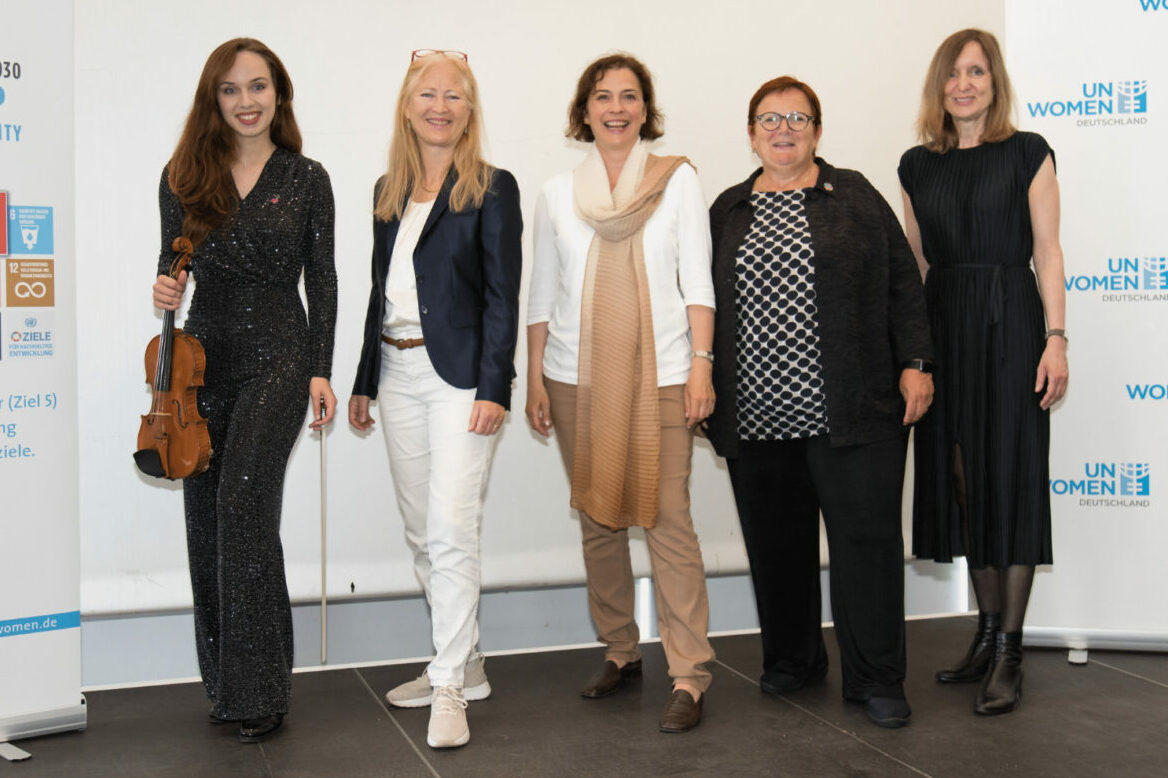
Minister Escobar and Dagmar Schumacher (Board Member UN Women National Committee Germany) closed the event, thanking all participants for their efforts. The main message was – again – that we are running against time and everybody is needed to make significant progress. Dagmar Schumacher highlighted that we are at a significant turning point, which is not only indicated by the Summit for the Future. Next year will be marked by numerous important anniversaries, including 30 years of the Beijing Declaration and Platform for Action and the 15th anniversary of UN Women. We will use these milestones to drive gender equality forward and increase the pressure – for a world in which everyone has the same chances and opportunities.